Revolutionizing
Corporate Expense Cards.
One company smart account holds the funds. Employees get signed spending permissions. AI agents get scoped sub-permissions. The contract enforces every limit before any ETH moves.

The Problem
Spend violations are found after the money is gone.
Corporate cards pre-load funds. Employees and agents get access to more than any single transaction needs. Rules get checked in audits, days after the spend.
Funds are pre-loaded
The employee has access to more money than any one purchase needs.
Agents have no built-in limits
A funded AI wallet has no on-chain constraint. Nothing reverts an overspend.
Rules live in the provider
The provider can change limits or be compromised. There is no proof the rules were followed.
How Allocard Works
Delegation, not pre-loading.
The company keeps the funds. Employees receive a signed permission to spend up to defined limits. That permission is checked by the contract on every transaction. Nothing moves until every caveat passes.
Every corporate card feature, enforced on-chain
Per-user spending limit
nativeTokenTransferAmount — lifetime ETH cap
Monthly allowance reset
nativeTokenPeriodTransfer — resets on a schedule
Per-transaction cap
valueLte — maximum ETH per transaction
Merchant restrictions
allowedTargets — whitelist of recipient addresses
Card cancellation
Delegation revocation — instant, cascades to sub-delegations
Virtual cards for agents
Agent delegations — scoped and revocable
Three spending modes using ERC-7710
Company → Employee → Agent
Redelegation. Agent executes.
The employee redelegates a portion of their budget to an agent. The agent executes independently within its scoped limits.
Company → Agent → Employee
Agent pays the employee.
The company delegates a reimbursement budget to the agent. The agent pays the employee directly on approved claims.
Company → Employee (direct)
Employee redeems directly.
The employee spends from their delegation to pay a merchant. Venice checks the purpose before the transaction executes.
Venice AI
Policy enforcement before every transaction.
Every agent request passes through Venice before execution. Venice reads on-chain caveats, the company's expense policy, and delegation-specific rules together, then returns a pass or reject decision with reasoning.
Venice and the contract check independently. Neither can override the other. Venice does not retain data between requests.
Three-layer policy context
On-chain caveats
Hard numeric limits from the delegation: lifetime cap, allowance, per-transaction max, allowed addresses.
Company expense policy
Natural language rules the employer sets. Applied to every agent request across the company.
Per-delegation rules
Agent-specific additions set when the employee creates the delegation.
Agent System
Three agents. Every expense workflow covered.
Each agent holds a smart account, receives a scoped delegation, and executes on-chain. No human approves individual transactions.
Books travel within the delegated budget.
Submit a destination and dates. Venice proposes an itinerary within the caveat limits. Approve, and the agent pays.
Venice: Reads the request, caveat limits, and policy. Returns an itinerary with estimated ETH cost.
Buys software. Checks for duplicates first.
Submit a tool category and team size. Venice checks existing subscriptions, picks a vendor, and executes on approval.
Venice: Checks existing tools for overlap, compares vendors against the delegation limit.
Pays employees back for out-of-pocket expenses.
Submit a description, amount, and optional receipt. Venice checks the claim. ETH transfers to the employee's wallet if it passes.
Venice: Vision model reads the receipt. Text model checks the claim against company policy.
Delegation Canvas
The full spending authority tree, at a glance.
Every delegation renders as a node. Company is the root. Employees branch from it. Agent redelegations branch from employees. Revoking any node revokes its entire subtree.
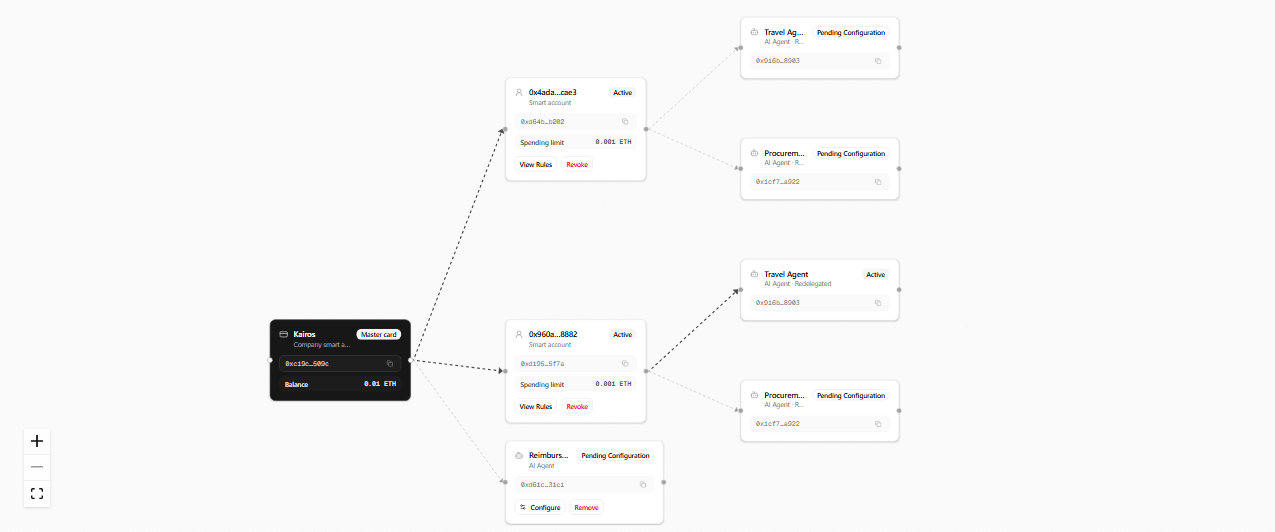
Employer view
Drag employees onto the canvas to issue a delegation. Configure caveats or revoke from the node.
Employee view
See your inbound delegation and every agent you have redelegated to. Open each agent's drawer from the canvas.
Cascading revocation
Revoking an employee node revokes every agent below it. One action, full subtree.
Tech Stack
What it runs on.
Next.js 15, MetaMask Smart Accounts Kit, Venice AI, and Neon Postgres. Deployed on Vercel. Network is ETH Sepolia.
Next.js 15 + React 19
Framework
MetaMask Smart Accounts
ERC-7710 / ERC-4337
Venice AI
openai-gpt-4o-2024-11-20
Neon + Drizzle ORM
Database
React Flow
Delegation canvas
ETH Sepolia
Network
Open demo. No setup required.
See it run on ETH Sepolia.
Connect a wallet. Issue a delegation. Redelegate to an agent. Watch ETH move under contract-enforced rules.